Monday, 19 July 2010

Dealing with the heat and YES, size DOES matter!


July here in the South of France has been very hot and for much of the time my studio  has been impossible to paint in during the heat of the day. Not only has it been way too uncomortable for me, but the paint has also been affected - becoming very sticky and difficult to work with, even when using a medium. Working fast in thin glazes may be the solution. I will need to experiment with the medium to get the consistency right and avoid further stickiness. I am going to try mixing the medium with a little pure turps – just as soon as I can get some – not  as easy as it sounds when you live up a mountain !

When it has been too uncomfortable I have abandoned the attempt altogether and spent my time sketching. I’ve been doing quick sketches of people, taking my sketch pad everywhere I go. Last week we took a trip down into Spain and found a restaurant sited just above a beach in a very pretty little cove, ideal for working unobserved - quick pen and ink sketches of all sorts and sizes of people!

But despite the heat and my poor husband's ears battered with my subsequent wingeing I have managed to complete two paintings this month. The one above is fresh off the easel and full of nostalgia for the gentle contours of my native Dorset now I am back in rugged mountain country. It fits the bill for painting smaller, which I vowed I would do following my recent exhibition in the UK. Size DOES matter when you are selling in an environment of  quaint country cottages and at a time when people are watching their pennies.

The second painting completed this month doesn’t fit the small is beautiful bill at all (it is 100 x 100). It is another large canvas in the mountain series. I wanted to paint the peak of the mountain opposite the house now that the snow has gone and when we first got back from the UK, there was still a little left just below the summit which was poking up above the clouds. I haven't quite decided what to do about the sky. I wanted a complete contrast to it's companion painting (on the right below) which I completed at the beginning of the year.


Earlier canvas also 100 x 100
  

Thursday, 24 June 2010

Waltzing Around the Easel - or how I perfected the art of procrastination!


I have been out of the studio for 5 weeks and now I'm back and have begun the oh so slow waltz around the easel, telling myself I will get back to the studio 'tomorrow.  It's remarkable, but after a week at home 'tomorrow' has so far not dawned!

You will know if you have been reading my blogs, that I have been exhibiting in Dorset in the UK.  It was an open studio event, with around 350 visitors coming to see my work, some to buy, others just to browse, all with lots of questions, many with their own painting stories to tell: all in all it was pretty tiring and I certainly don't envy the gallery owners who have to do it all the time! As a matter of fact I think I deserve a holiday!

Brilliant, there's another excuse to add to the ever growing list!  The odd thing is that I do have a lot of ideas that have been incubating while I have been away and I was really looking forward to getting going with them, but that means tackling those big blank canvasses. It is an inescapable fact a lot of artists will agree with, that  we are supremely inventive when it comes to perfecting this art of procrastination: the urgent calls to make, the dog to walk, the laundry to do, the TV to dust, the fridge to visit for one last snack....on and on it goes, even after the painting clothes have been put on, the brushes have been put out,  and the canvas is on the easel.

Soon of course I will get so disgusted with myself that I will take myself by the scruff of the neck and frog march me back into the studio and close the door!  Apart from anything else I need to replenish my stock, having sold well and left several canvasses behind to be 'aired' sometime this summer at Courcoux & Courcoux in Stockbridge, Hampshire.

So I will get back to work and this time with renewed determination to control the urge to paint bigger and bigger. The simple fact of the matter is that not many people have the luxury of large wall spaces to fill and an artist has to make a living.  Meanwhile, the image below was a work in progress on the easel when I left - needless to say I can't remember where it was leading me - but it is part of the mountain summit series (which you can see on my website) all of which really just have to be large paintings!


By the way I just finished an interview on another blog which is written by Steve Gray in Australia.  One or two of us on there now - follow the link if you have time.

Saturday, 5 June 2010

Grrrr ! Someone Copied One of My Paintings Without Permission !


Yesterday I was sitting in my Open Studio exhibition at Dorset Art Weeks just taking stock when a couple walked in to look at my work, clutching a photograph of a prize winning quilt that was based on the painting above!  How flattering - you might think and perhaps briefly I did.  However a small matter of copyright exists on original artwork and at the very least before you use someone else’s idea even in another medium, you must apply to the artist for permission to use it, which may or may not be granted or for which you may be required to pay a fee.

I think what hit me first when I had digested this information was the fact that the quilt maker had won a prize with it in a big exhibition – a prize for something that had hi-jacked my imagination.  Had this person bothered to contact me I might well have given permission provided that the piece was exhibited with full credit to me as originator of the image together with a reference to my web site for further information, but no such approach was ever made.

Obviously with the advent of images on the world wide web, it is more than likely that images will be copied, even if, as I do, you have a copyright notice on each and every page of your site (and blog!). In the Far East there are factories that specialise in copying work and closer to home too, so I suspect that It must be happening to a lot of artists.  But those that copy an image should beware, copyright laws exist for the protection of the artist and can be enforced, and as can be seen from my story, you never know when someone will put two and two together when they see a piece of work and tip off the originator of the piece.

If you live in the UK, both Artists Newsletter and DACS (the Design and Artists' Copyright Society) have information on Copyright and in the US I understand a ‘Cease and Desist’ notice can be very effective - if you are reading this in other countries please do leave your contribution to this blog.  There have also been a number of interesting discussions on this subject on Linkedin.

Thursday, 20 May 2010

Climbing Out of a Creative Abyss


"Everything I produce is rubbish! I’m useless! Why did I ever think I could call myself an artist! My work isn’t progressing it’s getting worse! I’m thinking of giving it up".  I’ve just come off the ‘phone from an artist friend, who is having one of ‘those’ spells. Ouch!  The only consolation for these bleak moments is the fact that numerous other creative people have felt this way too. The fact is it just goes with the territory. Numerous books have been written on the subject, and if you  ‘Google’ creative blocks you will find acres of helpful advice on how to overcome these bleak periods. The sooner you accept it and work out your strategy for moving on, the sooner it will pass.

So why does it happen?  I think it is probably a very good thing that it does.  Life always has two sides so why not creativity?  Without this experience would we strive for something better?  For me that is what the whole process is about – the idea that one day I may paint something seriously good.  The fact that I am unlikely ever to feel that I have done is neither here nor there; it is the motivation that is important!

Changing materials, canvas size or shape, looking at a subject from a different perspective, spending time working with another artist, or just going for a long walk with the dog on a beautiful day, can shift the gear. My daughter Beth Nicholas who is just starting out on her career as an artist found that getting all her jumbled thoughts down onto paper before she started work helped to clear her head, then she started writing those thoughts directly onto the canvas where they have now become an important part of her work.

Sometimes after these down periods I think I have made a discovery.  I produce what I term a ‘gateway’ painting – something new in my approach which has the potential to open up a new horizon and that will get me motivated again.  

There is a canvas ‘graveyard’ in my studio that bears witness to these periods: pieces that I have worked and worked and continue to feel dissatisfied with until I abandon them completely, regretting bitterly the volumes of wasted paint. But they don’t get chucked out, they eventually get re-used and the previous layers form a very helpful basis of texture for something new. Bonnard’s girl on the swing took 10 years to complete – I wonder if there  is something else lurking under the paint on that one?

Thursday, 13 May 2010

Have you ‘emerged’ as an artist? Now you're over 30, could you be 'over the hill'?


Recently I started thinking about the term Emerging Artists. I kept asking myself what does this actually mean ? How do you ‘emerge’ ?   Is there an age limit  - is over 30  ‘over the hill’ ? Do you have to win the Turner Prize ? Presumably Picasso ‘emerged’, I thought, but then what about poor old Van Gogh - did he ‘emerge’ posthumously ?  So I Googled the term and found a good blog by Edward Winkelman on the subject, with additional comments about age and the difficulty older artists have to get gallery exposure.

There is a serious gap in the market for the ‘Re-emerging’ Artist or even perhaps the 'Still Emerging' ones. You must understand, I’ve got nothing against young ‘Emergers’, quite the contrary in fact, I am currently rooting for my own ‘emerging’ daughter, but it seems that today it is often really hard for good artists of both sexes over the age of 30 to get their work shown in the key galleries. 

I know that since I was finally able to start working as a full time artist I’ve come across a lot of older women painters with huge talent who are not getting the exposure they deserve. I suspect there are also many women artists out there who, like me, had to hang up the apron and put away the paint brush for a good many years while they worked to pay the bills or bring up a family. So how do they get their work acknowledged?

Women artists were rare in the artistic Hall of Fame and it is largely put down to the fact that, with husbands and children to look after, they couldn’t give the time to focus on their art. (IMary Cassatt made it  but then she never married and had no children).  But the world has changed, for the better in that way, and more or less equal opportunities for women have brought a lot of younger talent into the spotlight in the creative field.

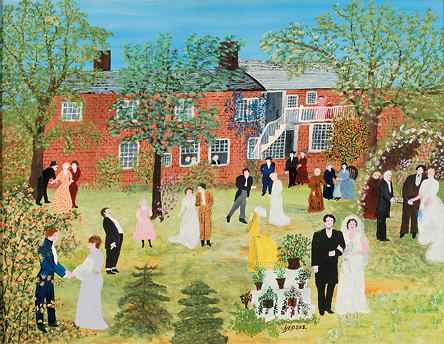
My conclusions on this musing? I think is time for a new art movement for women artists over 30! After all, Grandma Moses (painting above) took up painting when she was seventy- five and painted sixteen hundred paintings by her death at age one hundred and one! A movement that supports and celebrates the work of older women career artists and "re-emergers" and encourages, promotes and explores the opportunities for exhibition both together and individually around the world. My husband rather wittily suggested the name ‘The Old Mistresses’.  However, I prefered the title ‘The New Mistresses’ ! Anyone care to join me ?

Wednesday, 5 May 2010

More Thoughts on Pricing Art


My previous blog which touched on pricing has elicited one or two comments which have spurred me on to add a post script on the subject.  This can be a tricky issue for a lot of artists and for anyone reading this blog who is not a creative, it may be interesting to understand how we arrive at a value for our work.

The first two comments I have had come from two very different artists.
Painter Angela Canada Hopkins has an approach that I haven’t come across before – she prices by the square inch which she says « keeps her consistent ».
Ann Brauer who makes beautiful contemporary quilts believes that «  each piece has its price and its owner”.
I price according to my perception of its worth to me to let it go (see previous blog).
Some artists will price according to time spent and cost of materials, but whilst this obviously works from a commercial standpoint, I don’t feel it takes account of the quality of the work.

Then there are those who compare their work with their peers and fix a price accordingly.

It is also true to say that work may need to be priced according to the venue in which it is displayed – price it too low in a good gallery and the work will not sell.  I read a good article recently by Eric Rhodes who referred to an extremely successful artist who had failed to sell a piece at a low price and a few years later had shown the same piece at a price many times higher than the original one and sold it straight away!

So what conclusions should we reach? Fundamently, the artist must have faith in their own work – not always an easy one for the creative. (Given the title of this blog, I try to price mine on the days the roller coaster is at the top of the track!).

At the end of the day, for the art buyer I would say – remember the huge amount of work – both physical and emotional that usually goes into creating a piece and in my opinion – don’t try to negotiate. To other artists, if you have used another method of pricing it would be interesting to hear from you here.   

Monday, 3 May 2010

Pricing and Getting Ready for a Show


Every two years I take part in a huge open studio event in Dorset in the UK called Dorset Art Weeks.  Around 600 artists exhibit and as you will see if you follow the link to the website, the  work is mostly of an extremely high standard.  I really enjoy this show and this will be the third time I have taken part.  On each of the last two occasions around 300 people have visited my studio and I sold 10 or more canvasses  - by and large a much better response rate than showing in a gallery, with the added advantage of being on hand to talk to people about the work and see their reactions at first hand.


So right now I am beginning to prepare the canvasses I have been working on over the winter - painting the edges and wiring the backs.  I rarely frame them preferring to leave that up to the buyer. Personally, I really like the contemporary feel of a canvas hung directly on the wall.  Occasionally when I do frame I use just a thin wooden strip - about 3 cms - around the edges, usually painted white, which detracts least from the work.

Once all the work is ready, I put a price on it.  Probably the hardest part for a lot of artists, but I go by two rules of thumb.  My Dorset Mentor, artist Clare Shepherd said to me when I first exhibited with her that you had to work out what you were prepared to part with a piece for.  So I look at each individual canvas, think back to the work that went into it, evaluate it from my own critical standpoint and then use Clare's philosophy.  So far I think I have only got it wrong once when I allowed someone else's judgement to influence me and sold a piece too low.